

He Walked Into a Funeral… and Rewrote the Ending
Death walks into a funeral. And then Jesus walks in behind it.
Luke 7:11–35 puts two worlds side by side. One is marked by death, doubt, and hardened hearts. The other is marked by the authority and compassion of Christ. And you cannot stay neutral when those two collide.
The scene opens in a place called Nain. A widow is burying her only son. That is not just grief. That is the end of her future, her provision, her hope. Scripture says, “when the Lord saw her, he had compassion on her, and said unto her, Weep not” ~Luke 7:13. That is not empty comfort. That is authority about to act.
Jesus steps up to death itself and interrupts it. “Young man, I say unto thee, Arise. And he that was dead sat up, and began to speak” ~Luke 7:14-15. No ritual. No struggle. Just a word. Because when the Author of life speaks, death listens.
This is not just a miracle story. This is a revelation. Only God has power over life and death. Deuteronomy 32:39 says, “I kill, and I make alive.” And here stands Jesus doing exactly that. The people understood something weighty had happened, saying, “God hath visited his people” ~Luke 7:16. They were right. God was standing in front of them.
Then the passage shifts. John the Baptist, sitting in prison, hears about these works and sends messengers with a question: “Art thou he that should come? or look we for another?” ~Luke 7:19. This is the same John who pointed to Jesus and said, “Behold the Lamb of God” ~John 1:29. Now he is asking questions.
That matters. Even strong believers can struggle when circumstances close in. Prison will test what the wilderness once strengthened.
But notice how Jesus answers. He does not argue. He points to the evidence. “The blind see, the lame walk, the lepers are cleansed, the deaf hear, the dead are raised, to the poor the gospel is preached” ~Luke 7:22. That is straight out of Isaiah’s prophecy about the Messiah. Jesus is saying, Look at what Scripture said the Christ would do. Now look at what is happening.
Then He adds a warning wrapped in a blessing: “Blessed is he, whosoever shall not be offended in me” ~Luke 7:23. In other words, do not stumble over Me because I do not fit your expectations.
That is where many people fall. They want a Christ who fits their idea, not the One revealed in Scripture.
Jesus then turns to the crowd and speaks about John. He makes it clear John was no weak reed or compromised voice. He was a prophet, and more than a prophet. “Among those that are born of women there is not a greater prophet than John the Baptist” ~Luke 7:28. Yet even with that, many still rejected both John and Jesus.
And here is the heart of the passage. Jesus exposes the problem. “We have piped unto you, and ye have not danced; we have mourned to you, and ye have not wept” ~Luke 7:32. No matter what God sent, they found a reason to reject it. John came fasting, and they said he had a demon. Jesus came eating, and they called Him a glutton and a drunk.
It was never about the method. It was about the heart.
That same problem is alive today. People reject truth not because it is unclear, but because it confronts them. John’s message called for repentance. Jesus’ message called for surrender. And both cut too deep for those who loved their sin.
But Scripture says, “wisdom is justified of all her children” ~Luke 7:35. In other words, the truth proves itself in those who receive it. The evidence shows up in transformed lives.
So here is where this lands.
Jesus has authority over death. That means He is not just a teacher. He is Lord. The same voice that raised that young man is the voice that calls sinners from spiritual death. Ephesians 2:1 says, “you hath he quickened, who were dead in trespasses and sins.” This is not about improving your life. This is about being brought from death to life.
But you cannot come to Him on your terms. You cannot reshape Him into something more comfortable. You either receive Him as He is, or you reject Him.
And even for those who believe, there will be moments like John’s. Times where circumstances press in and questions rise. When that happens, do not look inward. Look back to what He has done and what Scripture says. Anchor yourself there.
The crowd in Luke 7 saw undeniable power and still walked away unconvinced. That is a warning. Exposure to truth does not equal surrender to truth.
So the question is not whether Jesus has shown enough.
The question is whether you are willing to receive what He has already made clear.
Read / Listen
Deuteronomy 5:1-6:25
Luke 7:11-35
Psalm 68:19-35
Proverbs 11:29-31
New Testament
Luke 7:11-35
Summary
Jesus Raises a Widow’s Son
Messengers from John the Baptist
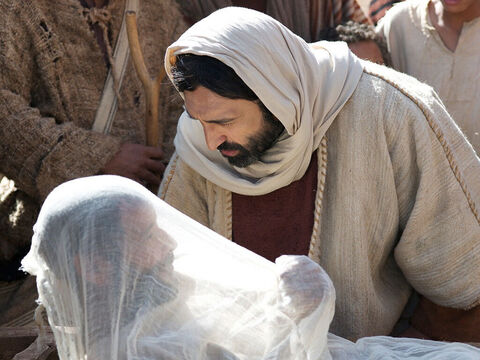
Jesus Raises a Widow’s Son
Overview: Luke 1-9 Video
Brat – A child, especially a spoiled or ill-mannered one.
In this parable He identifies His generation as brats, impossible to please, impossible to satisfy, belligerent, and all of those things we just mentioned.
These words of Jesus are directed at the people who are surrounding Him at the moment in which He spoke. He describes those people as brats. And while they are the immediate object of His words, the principle here is timeless. And there have been and there are and there will be brats by this kind of definition in every generation. He is speaking of people who respond to the gospel like a brat. The message of God to sinners about repentance, faith, forgiveness, salvation, does not receive from them the response that it should. And we know in the context of this particular chapter, since back in Luke 7:18 John the Baptist has been the main topic of discussion, so it really features Jesus talking about John the Baptist. And, of course, at this particular point in the history of the gospel there are only two preachers. There is John the Baptist and there is Jesus. The twelve have not yet been sent to preach, but there is John and there is Jesus.
So there are essentially two gospel preachers in the world, two that are preaching repentance and faith and forgiveness and salvation. But whether or not it has been the preaching of John or the preaching of Jesus, the men of this generation have given the same essential response and that’s that intractable, recalcitrant, obstinate, bratty kind of response.
The effect of these religious leaders was significant. They basically turned a populous who had affirmed their trust in John as the true prophet of God away from John. They effectively turned a populous who saw the miracles of Jesus, the wonders that He did, and heard His teaching, and saw Him cast out demons, and even raised dead people, they turned the people away from Jesus as well by their powerful influence. And ultimately in the end they got the whole population to scream for the blood of Jesus and have Him executed. Nobody seems to have minded either that Herod Antipas chopped John’s head off.
This is a tremendously important passage because this is Jesus’ own assessment of His generation. And what does He say? He says they’re basically brats. They’re like spoiled children who can’t be satisfied, who refuse to be satisfied. And all of this was the influence of the religious leaders, the scribes and the Pharisees, who were self-righteous. And because they were self-righteous they thought.
So Jesus confronts them and describes them as brats. And I…I just would remind you that Jesus never hesitated, neither did John the Baptist for that matter, to label people. I know that’s sort of not politically correct today in a tolerant environment, but it’s amazing how many pejorative terms are used to describe people by Jesus and John. When the religious leaders came down to the Jordan River to meet with John, he greeted them with this, “You snakes! Who warned you to flee from the wrath to come?” And in Luke’s record it would indicate to us that he even went…he even used those terms to extend even beyond the scribes and the Pharisees and to embrace all the people who were under their influence. And then after that description of them he further said to them, “You are nothing but chaff for burning.”
What Jesus said is even more extensive. Jesus called these self-righteous people hypocrites, blind, sons of hell, fools, robbers, self-indulgent. He said they were unclean tombs, outside whitewashed and inside dead men’s bones. He called them snakes. He called them vipers. He called them murderers. And all of that in one speech in Matthew 23. So by comparison, “brats” is mild but it really does open up insight for us.
Why? Why did they say it? Very simple, they hated his message. They hated his message. Please, folks, understand this, they hated his message. Their hearts were hard, impenetrable. They rejected the divine diagnosis of their true condition. The Pharisees and the scribes, they would not accept the fact that they were snakes, that they were chaff, that they were sinful, that they needed to repent. They hated to be called sinners and they hated the fact that there was forgiveness for those who were wretched. They hated the message of sin and grace. They hated it. It was the message they hated, but they attacked the man and they attacked his style to justify their rejection of his message. They said he’s a maniac. He’s a madman. He’s demented. He’s demonic. They made his style the issue because they hated his substance. That’s why I subtitled this message “Style or Substance.” When people don’t want to receive the truth, very often, in order to justify their rejection of the truth they will attack the style of the preacher. So many preachers fall for that and they think that if they’re going to be able to be received by people, they’ve got to change the style. They’ve got to be slick, suave, and glib, and acculturated somehow. And they’ve got to be up-to-date with the vernacular of thinking in their society. ~ John MacArthur

Dr. J. Vernon McGee – Thru the Bible
Luke 05-07 – J Vernon Mcgee – Thru the Bible
Views: 5
