
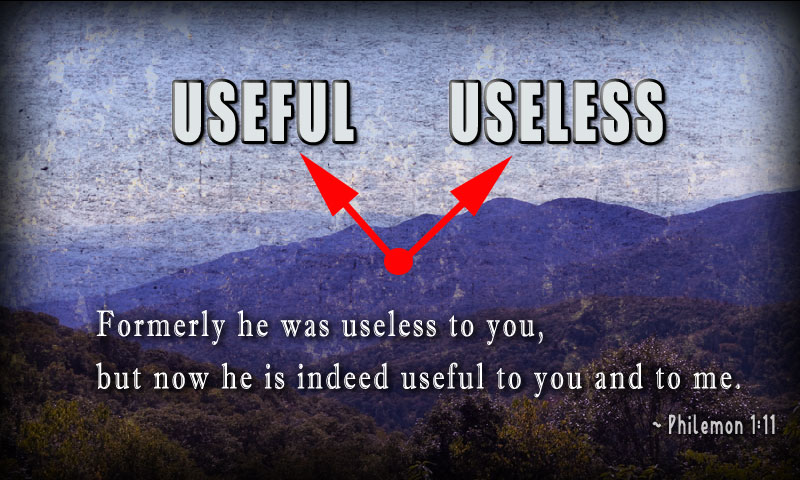
Which in time past was to thee unprofitable,…. Yea, injurious and hurtful; one that was an eye servant, that loitered away his time, and set an ill example to fellow servants; and not only so, but embezzled his master’s goods, and robbed him, and run away from him. So every man, in his state of unregeneracy, is an unprofitable man.
Lamentations 1:1-2:22
Philemon 1:1-25
Psalm 101:1-8
Proverbs 26:20
Read Today’s Scripture – Click Here
Click on the Play Button below to Listen to Today’s Scripture
New Testament: Philemon 1:1-25
Summary: Paul’s Plea for Onesimus
Formerly he was useless to you, but now he is indeed useful to you and to me. ~ Philemon 1:11
Which in time past was to thee unprofitable,…. Yea, injurious and hurtful; one that was an eye servant, that loitered away his time, and set an ill example to fellow servants; and not only so, but embezzled his master’s goods, and robbed him, and run away from him. So every man, in his state of unregeneracy, is an unprofitable man, Romans 3:12 unprofitable to God, to men, and to themselves; their sins will not profit them, though they may promise them liberty and pleasure; nor will their riches, should they lose their own souls: nor their own righteousness, in the business of justification and salvation; nor even an outward profession of religion: yea, they are not only said to be unprofitable, but are represented as good for nothing; hence they are compared to dishonourable and unserviceable vessels; to briers and thorns, and the earth which brings them; to the salt that has lost its savour, and is fit neither for the land, nor for the dunghill; to rotten figs, to chaff, and dross of metals: yea, they are hurtful and injurious to themselves, on whom they bring ruin and destruction; to others, to wicked men, whom they more and more corrupt, and harden in sin; and to good men, whom they grieve; and also to the interest and glory of God, whose laws they transgress, and against whom they sin, affront his justice, and provoke the eyes of his glory,
But now profitable to thee and to me; that is, he was now likely to be so, to be profitable to Philemon, as a servant, and to the apostle as a ministering brother. Some think there is in this an allusion to his name Onesimus, which signifies “profitable”; before he did not answer to his name, but now he was a true Onesimus, really a profitable person; grace, of an unprofitable man, makes a profitable one. Such an one is profitable to himself; his godliness is gain unto him, it having both the promise of this life, and of that which is to come; and he is profitable to others, if he has gifts qualifying him for the public work of the ministry, as Onesimus seems to have had; then he is made and becomes very useful to many for conviction, conversion, comfort, and edification; and if only a private believer, he is often profitable to others, by relating the work of God upon his soul; he is serviceable to the interest of Christ, for the support of the ministry, and supply of the poor; he is useful by his good examples, and prayers, in the neighbourhood, town, city, or nation, in which he dwells. This argument from profit, the apostle knew would be an engaging one.
Overview: Philemon – Click Here
Views: 4
