

Daily Bible Reading and Study Rooted in Scripture Alone
Instant answers to your Bible Questions? Ask me!
September 24
Isaiah 43:14-45:10
Ephesians 3:1-21
Psalm 68:1-18
Proverbs 24:1-2
Read Today’s Scripture – Click Here
Click on the Play Button below to Listen to Today’s Scripture
New Testament: Ephesians 3:1–21
Summary: The Unsearchable Riches of Christ
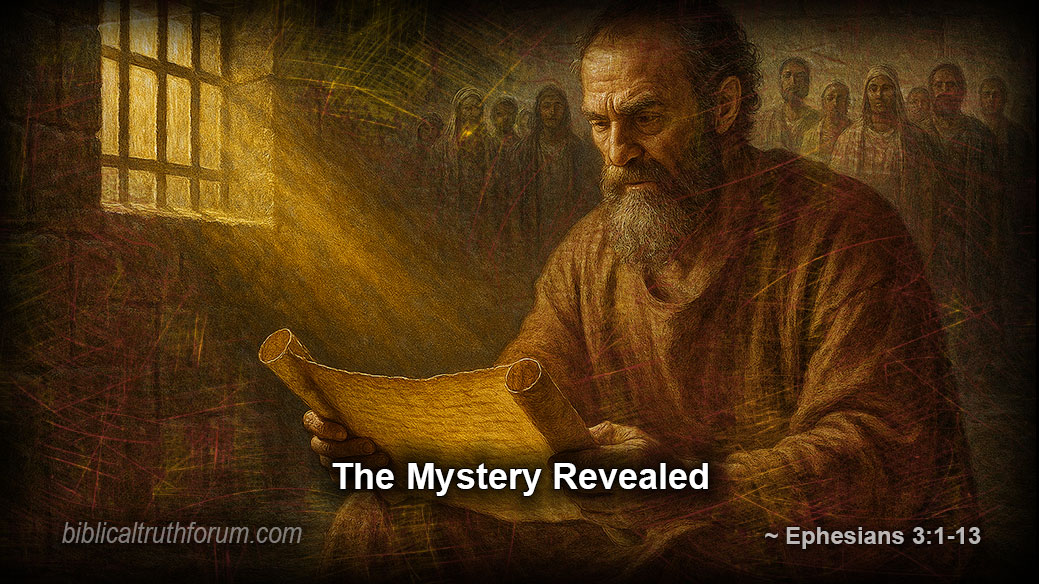
The Mystery Revealed
Paul was in prison while writing these words. If he were ashamed, he could have done what many pastors do and gotten off the road. He could have been arrested for fraud or some other trumped-up charge. Instead, he was in chains, bold in his confession because he was filled with a truth worth any chains, worth any humiliation, worth any suffering. Paul called himself “a prisoner of Christ Jesus on behalf of you Gentiles” (Ephesians 3:1). There is an application there for us. The gospel does not change with our circumstances. God does not stop moving forward just because His servants are in chains. In fact, He often uses persecution and suffering to move His gospel to fresh places and to open new doors.
Paul’s task was to proclaim something that had been kept secret for ages, a mystery that human wisdom could not know but that God chose to reveal by His Spirit. In verse 5, he states the purpose of the revelation: to preach the unsearchable riches of Christ.
This mystery, Paul goes on to explain, is that Jews and Gentiles, both, are one in Christ. “This mystery is that the Gentiles are fellow heirs, members of the same body, and partakers of the promise in Christ Jesus through the gospel” (Ephesians 3:6). Gentiles were non-Jews and members of any other nationality. In short, there are no second-class citizens in the kingdom of God. Every believer in Jesus Christ is adopted as a son or daughter of God, and every believer has an equal claim on the promise of eternal life, forgiveness of sins, and glory with God.
Paul also characterizes his ministry as one who proclaims “the unsearchable riches of Christ” (Ephesians 3:8). What riches are those? Riches so deep and so vast that you could not reach the bottom with a hundred shovels digging for a hundred years. This world preaches riches, status, and pleasure, money, fame, and sex. They are hollow things that tarnish and wear out. Christ, in contrast, offers a treasure that will never fade. Christ said as much Himself: “Lay up for yourselves treasures in heaven, where neither moth nor rust destroys and where thieves do not break in and steal” (Matthew 6:20).
The point of this revelation, the reason God broke the code, was not so that Paul and Timothy could make life a little more comfortable. The reason God revealed this mystery was to show the wisdom of God to the rulers and authorities in heavenly places, and that means to every living soul (Ephesians 3:10–11). The church, the body of Christ, is God’s theater in which He puts on display His eternal purpose in Christ Jesus our Lord (Ephesians 3:10–11). Each of us who believes in Christ is part of God’s plan to put His wisdom on display, to show the power of His grace.
Paul concludes this section with a promise: “In whom we have boldness and access with confidence through our faith in Him” (Ephesians 3:12). Do you understand what that means? You do not need a priest or an appointed time or a ritual or a list of good works to come before the Lord. By the finished work of Christ, you can approach the throne of grace with boldness (Hebrews 4:16). That is the kind of access that no earthly ruler can take away and no amount of suffering can silence.
When trouble comes, don’t lose heart. Paul, in chains, tells the believers not to be disheartened because his suffering is also working for God’s glory (Ephesians 3:13). The same is true for us. When suffering comes your way for the sake of Christ, it is not in vain. In fact, it is a sign that the gospel is real and it is unstoppable.
The mystery, kept secret for ages, has been revealed. The question is, are you living as one who has entered into that light? Are you grasping after the unsearchable riches of Christ or are you clinging to the empty promises of this world? The door stands open. Through faith in Jesus, you have bold access to the living God.
Old Testament: Isaiah 43:14–45:10
The Lord reminds Israel that He is their Redeemer, Creator, and King. He promised to make “a way in the wilderness, and rivers in the desert” (Isaiah 43:19, KJV). God’s past works reveal His faithfulness, but His people must not assume that He can work only in ways they have already seen.
Israel had burdened God with sin rather than honoring Him. Yet the Lord declared, “I, even I, am he that blotteth out thy transgressions for mine own sake” (Isaiah 43:25, KJV). Forgiveness rests upon God’s mercy, not upon man’s ability to repair his own guilt.
Isaiah exposes the foolishness of idolatry. A man burns part of a tree for warmth and cooking, then forms the rest into an idol and asks it for deliverance. Modern idols may look different, but people still trust money, political power, possessions, pleasure, human wisdom, or themselves instead of the God who made them.
God named Cyrus as the ruler who would permit Jerusalem and the temple to be rebuilt. Cyrus did not know the Lord, yet God used him to accomplish His purpose. Earthly rulers may not recognize God, but they cannot escape His authority.
The Lord declares, “I am the LORD, and there is none else, there is no God beside me” (Isaiah 45:5, KJV). There are not many true gods or many equally valid ways to reach God. The Lord alone is God, and salvation is found only in Jesus Christ.
The passage warns the creature not to argue with his Creator: “Woe unto him that striveth with his Maker!” (Isaiah 45:9, KJV). We may not understand everything God does, but He remains righteous, sovereign, and worthy of trust.
Psalm: Psalm 68:1–18
Psalm 68 begins with a call for God to arise and scatter His enemies. The wicked cannot stand before Him, but the righteous are commanded to rejoice before God.
God’s greatness does not make Him indifferent to the helpless. He is “a father of the fatherless, and a judge of the widows” (Psalm 68:5, KJV). He cares for those whom the world often overlooks and commands His people to do the same.
Paul later applies Psalm 68:18 to the victory of Jesus Christ. Christ defeated sin and death, ascended on high, and gives gifts to His people. The conquering King has not abandoned those who belong to Him.
Proverbs: Proverbs 24:1–2
“Be not thou envious against evil men, neither desire to be with them” (Proverbs 24:1, KJV). Evil people may appear successful, powerful, or free from consequences. Scripture tells us not to envy them or desire their company.
Their hearts study destruction, and their lips speak mischief. We must judge success according to God’s Word, not by wealth, popularity, influence, or temporary comfort. It is far better to walk humbly with God than to gain the world while sharing in its rebellion.
Bringing It Together
These readings reveal a God whose authority reaches over nations, rulers, the church, and every individual life. He used Cyrus to accomplish His purpose, scattered His enemies, cared for the helpless, and revealed His saving plan through Jesus Christ.
Ephesians 3 shows that believing Jews and Gentiles are brought together in one body through the gospel. No one earns a place in that body through nationality, religious ceremony, status, or good works. Salvation and access to God come through faith in Jesus Christ.
The world offers temporary riches and invites us to envy those who prosper through evil. Paul points us instead to “the unsearchable riches of Christ.” Everything the world offers will pass away, but what believers possess in Christ can never be taken from them.
Discussion Question: Are you seeking the temporary riches and approval of this world, or are you learning to value the unsearchable riches found in Jesus Christ?
Overview: Ephesians – Click Here
Views: 19




e-Sword Here PC – free bible study software for Windows users.
iPad version is here.
You can listen and read along
Click Here
Have you ever considered just how much is riding on your assumption that the Bible you read, study, and take to church is completely accurate?
How Can I Make Daily Bible Reading Authentic?
If you are interested in
Online Internet Evangelism
Click Here
Do-You-Have-Reservations?
Go Through The Bible In A Year
Click on the Read to pull up the bible readings for the day.
Click on the Listen to listen to the audio bible readings for the day.
————————————————–
You Need to Know the Bible for Yourself
Everybody needs to know what the Bible really says: what it says about God, Jesus, the Holy Spirit, salvation and eternity, etc. Don’t depend on what a church or some famous preacher tells you. If you depend on Hollywood, the History Channel, or a magazine for the most important information you will ever need to know. You may end up lost forever not knowing what God has written down for you. He wants you to spend eternity with Him.
You need to know Jesus before you can be saved. The bible is all about who Jesus is and what He has done for you. He has a gift for you and it is completely free. But if you don’t know Him, you will not be in the Kingdom of God with Jesus who gave His very life for you.
“Not everyone who says to Me, ‘Lord, Lord,’ will enter the kingdom of heaven, but he who does the will of My Father who is in heaven will enter. “Many will say to Me on that day, ‘Lord, Lord, did we not prophesy in Your name, and in Your name cast out demons, and in Your name perform many miracles?’ “And then I will declare to them, ‘I never knew you; DEPART FROM ME, YOU WHO PRACTICE LAWLESSNESS.’ ~ Matthew 7:21-23
There is an absurd amount of very bad information out in the world today about the Bible. You will only know the truth if you study the bible for yourself. And if you study the bible and ask The Holy Spirit to open your eyes to the truth He will and it will change your life forever.
How to Study the Bible for Yourself / Save Yourself Some Pain
|
Bible tools that will let you listen to a section of the bible and read at the same time. If you do this each day you will have completed the entire bible in one year. |
Read and Listen To The Whole Bible In A Year
Views: 4046
