

Daily Bible Reading and Study Rooted in Scripture Alone
Instant answers to your Bible Questions? Ask me!
February 3
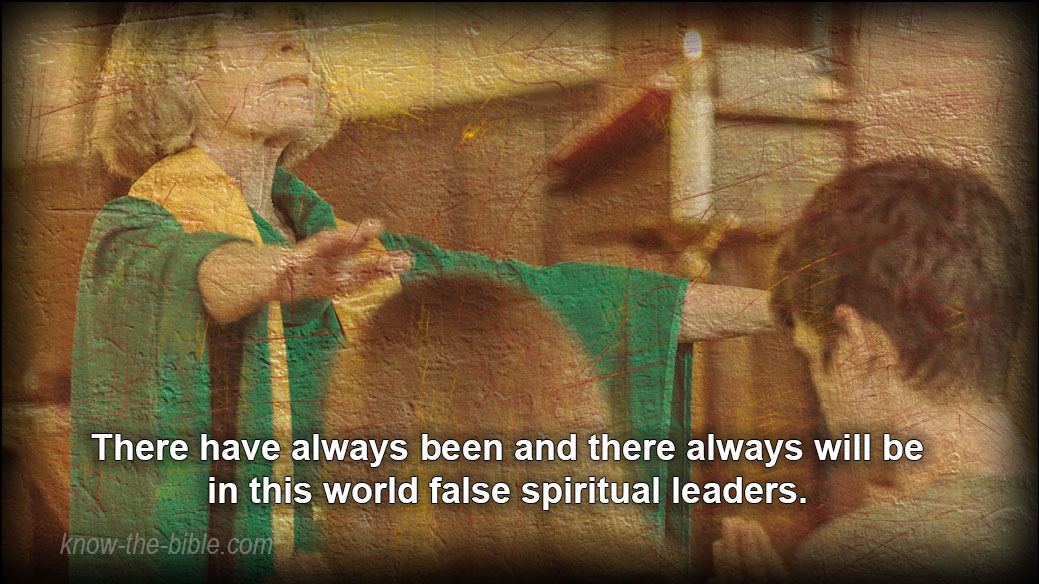
There have always been and there always will be in this world false spiritual leaders who pretend to represent God but in fact do not represent God. The Old Testament talks about them, identifies them, and warns people to stay away from them. The New Testament does the same. In fact, Moses was in conflict with them in Egypt. Jeremiah was fighting with them in Judah. Ezekiel faced them and called them foolish prophets that followed their own spirit and have seen nothing.
Our Lord warned of them as false Christs and false prophets who shall show great signs and wonders. The apostle Paul struggled against them as preachers of another gospel in Galatians chapter 1, and purveyors of the doctrine of demons he called them in writing to Timothy. Peter said they were false preachers who secretly bring in damnable heresies, and they are like dogs who return to lick up their own vomit. John, the apostle, saw a coming antichrist and many antichrists already present who denied Jesus as the true Christ. ~ John MacArthur
Exodus 17:8-19:15
Matthew 22:34-23:12
Psalm 27:7-14
Proverbs 6:27-35
Can a man scoop fire into his lap without his clothes being burned? Can a man walk on hot coals without his feet being scorched? So is he who sleeps with another man’s wife; no one who touches her will go unpunished. ~ Proverbs 6:27-29
Read Today’s Scripture – Click Here
Click on the Play Button below to Listen to Today’s Scripture
New Testament: Matthew 22:34-23:12
Summary:
The Great Commandment
Whose Son Is the Christ?
Seven Woes to the Scribes and Pharisees
Overview: Matthew 14 – 28 – Click Here
Jude saw them and called them deluded dreamers who defile the flesh. And Paul may have summed it up well when he said they are wolves whose desire is to enter in, not sparing the flock. They’re always present and they’re always eager to counterfeit the work of God. In the second coming of Jesus Christ, as the great event unfolds, we see the false prophets amass and congregate that’s portrayed for us in those apocalyptic visions of Scripture that look to that future time.
And it seems to us that that may be the time when they flourish as it were in their heyday, but if there is a time equal to that time for the working of false prophets, it must have been in Palestine during the time of the Lord Jesus Christ. For in His first coming, all hell amassed its forces for a three-year assault on Him and His truth. Therefore, false spiritual leaders take a very high profile, a very great visibility in the gospel record. And in this particular chapter, we hear the Lord Jesus Christ confront them with a denunciation that blisters and burns as it comes from His lips.
This is the last public speech, and it is a denunciation of these false religious leaders and a warning for the people to stay away from them. It is a very severe, a very serious presentation but a very necessary one. They are false shepherds, they are wolves in sheep’s clothing, they damn people, and they must be avoided, and our Lord pulls no punches in making that abundantly clear.
Now, it isn’t the first time that He has denounced them. A year earlier He had and a few months before, as recorded in Luke 11, He had said some very similar things to what He says now. So He’s already confronted them and called them what they truly were, but now he warns the people particularly to stay away from them because they damn men’s souls.
And it is essential that the people be warned to stay away from the false religious leaders and to be turned toward the true spiritual leaders. And He knows that the true spiritual leaders will be His disciples who, after His ascent to heaven, will be filled with the Spirit of God and will go everywhere preaching the gospel. And He wants the people to be ready to listen to them.
And so He warns the people about the false spiritual leaders so that their hearts will be open to the true ones. And in a sense, He’s setting us His disciples for their ministry. That’s why down in verses 8 to 12, He calls His disciples to be distinctly different than these false spiritual leaders are. So it isn’t just a denunciation of the leaders, it isn’t just a warning of the people, it is both of those with a purpose, that the people might listen to those who are true spiritual leaders, who manifest in fact the very opposite kind of characteristics to the ones that He will denounce in the false leaders.
The Lie of “I Can Handle It
Proverbs 6:27–35
Sometimes a man doesn’t have to argue with fire to get burned. The question posed in Scripture pulls back the curtain that reveals the lie before it fully develops: “Can a man take fire in his bosom, and his clothes not be burned?” ~Proverbs 6:27.
God does not ask rhetorical questions because He needs information. He asks them because the answer is self-evident to anyone who is not lying to himself. Fire burns. Sin scars. Adultery destroys. This is not hyperbole. This is reality.
Men still want to reason with fire. They hold it close to their hearts. They tell themselves they are exercising caution. It’s harmless. They say it’s only looks. Only messages. Only thoughts. Only curiosity.
God slices through that rationalization with the follow-up question: “Can one go upon hot coals, and his feet not be burned?” ~Proverbs 6:28. The answer is a definitive no. There is never a time when that answer changes. There is no harmless, close encounter with a sin God has already declared evil. The wounds may not be immediate, but they will be there. Scripture is never wrong about consequences.
Now the Word gets personal. “So he that goeth in to his neighbour’s wife; whosoever toucheth her shall not be innocent” ~Proverbs 6:29.
God does not say he might be considered innocent in the eyes of others. He will not be innocent. Period. Guilt is not defined by your feelings the next morning. God determines guilt before the transgression occurs. When a man chooses to step across the boundary God has already established, innocence is forfeited. Nothing you can say after the fact will reinstate it. No matter how secretly you think you have gotten away with it, it does not make it true.
People try to soften adultery by comparing it to other sins. God stops them in their tracks. “Men do not despise a thief, if he steal to satisfy his soul when he is hungry” ~Proverbs 6:30.
Even stealing to feed his family is stealing. But Scripture makes allowances for why a man may do what is still declared sin. Then God sets the contrast. “But if he be found, he shall restore sevenfold; he shall give all the substance of his house” ~Proverbs 6:31.
Stolen property can be returned. Monetary loss can be replenished. One can make amends for the damage.
Someone cannot undo adultery. “But whoso committeth adultery with a woman lacketh understanding: he that doeth it destroyeth his own soul” ~Proverbs 6:32.
It is not simply poor judgment in God’s eyes. When God says it destroys a man’s soul, the Hebrew implies Self-destruction. Turn it over and over in your mind. There is no walking away untouched by the fallout. Adultery damages a man’s own heart. It crushes future confidence. Ruins the ability to celebrate personal joy. It murders his own soul by degrees.
“The aftermath will not be silent” ~Proverbs 6:33 (The Voice). Adultery is a wound to another human being. The world tells us time heals all wounds. But some scars never fully fade in Scripture. Not because God condones the harm, but because men are injured by sin in the real world. Forgiveness may clear a guilty conscience before God, but it will not undo all consequences between men. Grace does not ignore the truth.
“But the curse shall hunger” ~Proverbs 6:34 (The Voice). Now God brings in the final warning no man wants to face but every man should hear. Adultery provokes jealousy. And jealousy is as much about pride as it is love. You do not get to control the feelings of another person when you assault what they most cherish in life. Sin is never a personal issue because it always releases repercussions you cannot control.
God gives no get-out-of-jail-free card. “He will not regard any ransom; neither will he rest content, though thou givest many gifts” ~Proverbs 6:35.
Some men will not be bought off. Some relationships cannot be redeemed with money. And some lines, once crossed, will irreparably change the landscape.
It doesn’t whisper. It warns. Don’t test God. Listen.
“He asketh not questions concerning multitude of gifts” ~Job 31:27.
The message is not seductive. In fact, it’s the opposite. It does not invite you to figure out how close you can get to the flame. It asks why you would even consider touching fire in the first place. Wisdom is never flirtatious with sin. She listens, while there is still time to listen.
The man who fears God does not push the boundaries to see how far grace will stretch. He flees from what God has clearly declared will destroy him. ~Chuck MacDonald
Scripture leaves no room for confusion. The question is not whether we know what God says about adultery.
The issue is whether we will listen to what He says before we get burned or learn it the hard way after we sin.
Views: 64

You can listen and read along
Click Here
Have you ever considered just how much is riding on your assumption that the Bible you read, study, and take to church is completely accurate?
How Can I Make Daily Bible Reading Authentic?
If you are interested in
Online Internet Evangelism
Click Here
Do-You-Have-Reservations?
Go Through The Bible In A Year
Click on the Read to pull up the bible readings for the day.
Click on the Listen to listen to the audio bible readings for the day.
————————————————–
You Need to Know the Bible for Yourself
Everybody needs to know what the Bible really says: what it says about God, Jesus, the Holy Spirit, salvation and eternity, etc. Don’t depend on what a church or some famous preacher tells you. If you depend on Hollywood, the History Channel, or a magazine for the most important information you will ever need to know. You may end up lost forever not knowing what God has written down for you. He wants you to spend eternity with Him.
You need to know Jesus before you can be saved. The bible is all about who Jesus is and what He has done for you. He has a gift for you and it is completely free. But if you don’t know Him, you will not be in the Kingdom of God with Jesus who gave His very life for you.
“Not everyone who says to Me, ‘Lord, Lord,’ will enter the kingdom of heaven, but he who does the will of My Father who is in heaven will enter. “Many will say to Me on that day, ‘Lord, Lord, did we not prophesy in Your name, and in Your name cast out demons, and in Your name perform many miracles?’ “And then I will declare to them, ‘I never knew you; DEPART FROM ME, YOU WHO PRACTICE LAWLESSNESS.’ ~ Matthew 7:21-23
There is an absurd amount of very bad information out in the world today about the Bible. You will only know the truth if you study the bible for yourself. And if you study the bible and ask The Holy Spirit to open your eyes to the truth He will and it will change your life forever.
How to Study the Bible for Yourself / Save Yourself Some Pain
|
Bible tools that will let you listen to a section of the bible and read at the same time. If you do this each day you will have completed the entire bible in one year. |
Read and Listen To The Whole Bible In A Year
Views: 3680
Recent Comments